
You always hear terms like “Grand Slam,” “best-of-five sets,” “net cord,” “break of serve,” and “tiebreak game.” Why are tennis rules so hard to understand?
Don’t worry, this article will use the simplest way to help you fully understand tennis rules, how to keep score, and common terms-so you can become the one who understands tennis best when watching a match!
How is tennis played? From “Games” to “Set” to “Match”
A tennis match is made up of many games, simply put, it starts with “points” (love, 15, 30, 40), accumulates into “games,” then into “sets,” and finally the player who wins the most sets wins the entire match.
The Tennis Scoring Hierarchy
You can remember it like this: points → games → sets → the player with the most sets wins!
For example: To win a men’s French Open match, you need to win “three sets” (five-set, three-win format).
Usually, winning 6 games (and leading by 2 games) takes a set, and each game requires at least four points (and leading the opponent by two points).
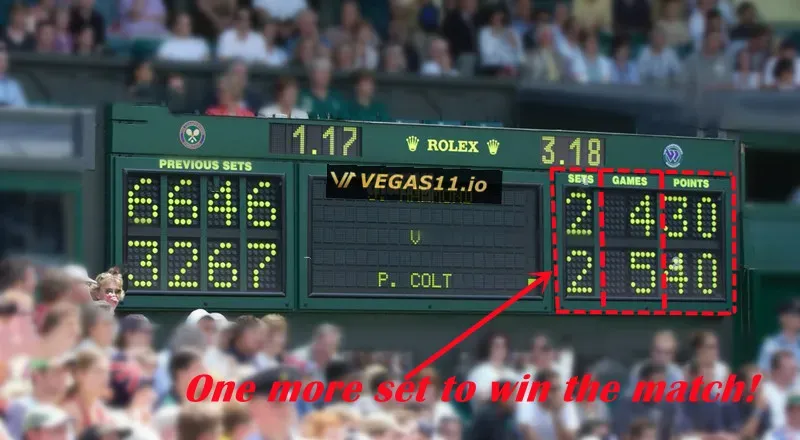
Tennis Scoring System (Why 15, 30, 40?)
Tennis scoring doesn’t use 1, 2, 3. Instead, the first point is called 15, the second point is 30, and the third point is 40 (PS: 40 is the maximum). The next point after 40 wins a “game”.
Zero points in tennis is called Love.
POINTS
Tennis scoring starts from 0. The first point is 15, the second is 30, and the third is 40. If you score again, you win a Games!
0 points is called “Love,” which is said to come from the French word “L’oeuf” (meaning egg, the shape of it is similar to the number 0).
Deuce and Advantage
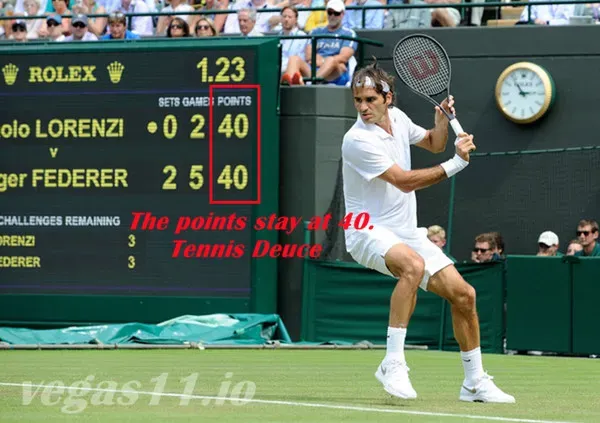
If both players reach 40 points (40-40), it’s called Deuce. At this point, you need to win two consecutive points to take this GAMES!
After winning the first point, you enter Ad (Advantage). If you win another point, you take this Games ; but if the player with Ad loses a point, the score returns to Deuce.
GAMES
When you win enough “points” (usually by at least two points more than your opponent), you win a GAMES.
You need to win 4 points (at least two more than your opponent) to take a GAMES; for example, at 40-15, if you score again, you win that GAMES!
Example:
| Score Situation | What Happens on the Next Point? |
|---|---|
| 40-0, 40-15, 40-30 | Win one more point to win the GAMES |
| 40-40 (Deuce) | First gain Advantage, then win one more point to win the GAMES (must win two points in a row) |
SETS
- When you win enough GAMES, you win a SET.
- The player who first wins 6 games wins the SET.
But here’s an exception:
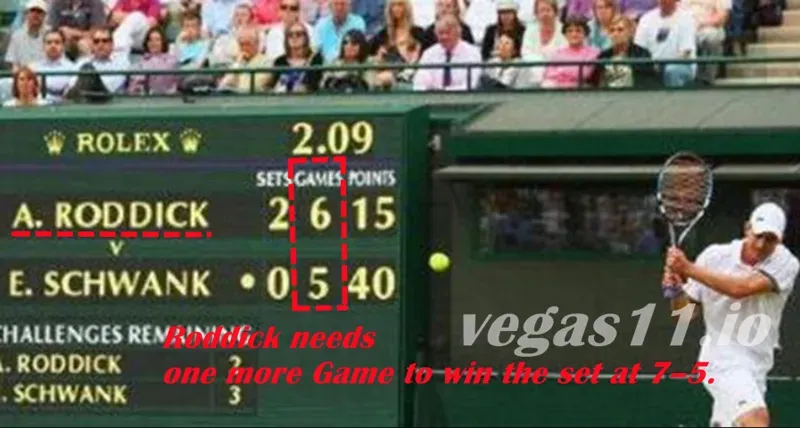
If the score reaches 6–5 (you have won 6 games and your opponent has won 5), you must win one more GAMES to extend the lead to 7–5 in order to win the SETS.
Tiebreak
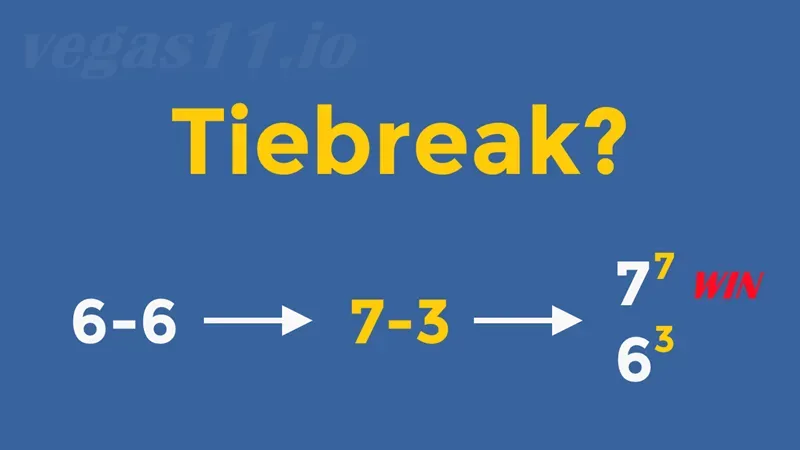
- If both players reach 6–6 in GAMES, a Tiebreak is played!
- In a tiebreak, the score is counted as 1, 2, 3, and so on.
- The first player to reach 7 points (with at least a 2-point lead) wins the SET.
How is the tennis score shown after 40?
Read More: French Open 2025: Indian Players & How to Bet Live
When both players score 40-40, they enter a special state called Deuce (even score), and the scoring doesn’t go up to numbers like 50, 55, or 60.
The score will enter the following cycle:
- Deuce
- Advantage Player A (Player A leads)
- Deuce (tied again)
- Advantage Player B (Player B leads)
- Deuce
- Advantage Player A
- Player A wins the GAME
On-site staff will announce the score verbally: Deuce ↔ Advantage ↔ Deuce… until one player wins two points in a row.
Ball Out of Bounds? Net Cord? Common Scenarios at a Glance!
In a tennis match, what happens if the ball goes out of bounds or hits the net (called a net cord) and lands in the opponent’s court—is that a win? I’ll answer your questions!
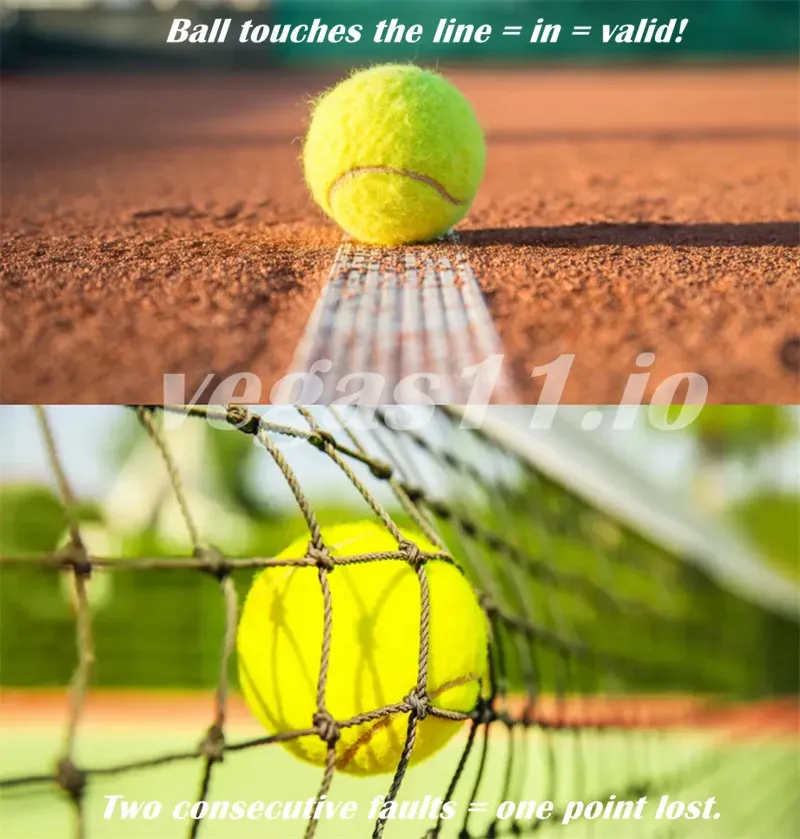
- How Is an Out-of-Bounds Ball Counted? If the ball lands beyond the sideline or baseline (even touching the line counts as out), you lose the point!
- Foot fault on serve: stepping on the line = one service fault.
Two consecutive faults = lose the point. - Does a Net Cord Count as a Win? If the ball hits the net during a serve and lands in the opponent’s service box, it’s valid, and you can continue playing for the point;
but if it hits the net during a rally and the opponent returns it, you must keep playing—you won’t win the point directly.
- Serving two consecutive faults results in directly giving the opponent 1 point!
If the ball lands twice in your court, goes out of bounds, or fails to clear the net, the opponent will get 1 point directly.
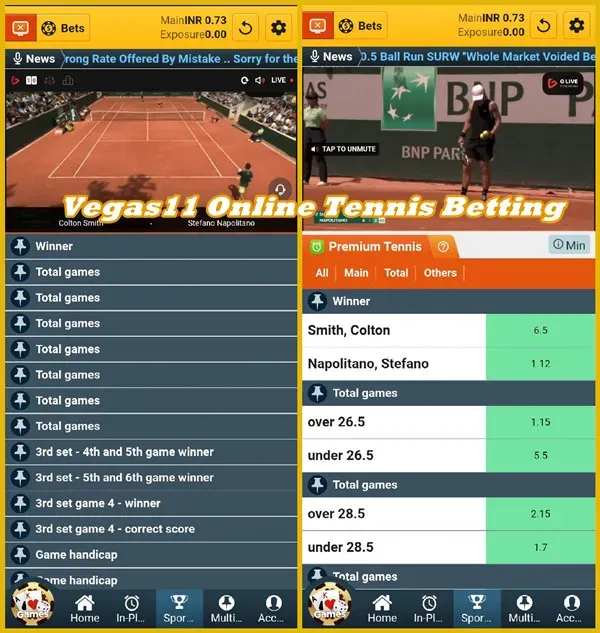
₹100 online tennis betting
With just ₹100, you can place bets on the four Grand Slam tournaments (Australian Open, French Open, Wimbledon, US Open) through online casinos, as well as popular ATP and WTA matches!
Try match winner (pick the winner), set winner (guess who wins a set), or total games over/under (predict if games exceed, like 22.5).
Related Reading: New to US Open 2025? Here’s Who to Watch & How to Bet
Are the scoring rules the same in all four Grand Slams?
The four tournaments-Australian Open, French Open, Wimbledon, and US Open — use the same basic scoring system, but slightly different:
- Men play best-of-five SETS;Women play best-of-three SETS
- Wimbledon: No final SET tiebreak in the past, but since 2019, a special tiebreak is played at 12–12
- French Open: No final SET tiebreak in the past, but since 2022, a tiebreak is played at 6–6, same as the others
Read More: No white, no Wimbledon! Your 2025 Wimbledon guide is here
Common Tennis Term – What Is a Tiebreak?
In tennis, a player usually wins a SET by winning 6 GAMES with at least a 2-game lead, such as 6–4. But if the score reaches 6–6, the set goes into a tiebreak.
Unlike regular scoring (15, 30, 40), the tiebreak uses simple points: 1, 2, 3, and so on.
The first player to reach 7 points and lead by at least 2 wins the SET.
If the score in the tiebreak becomes 6–6, they keep playing until someone leads by 2 points, like 8–6 or 9–7.
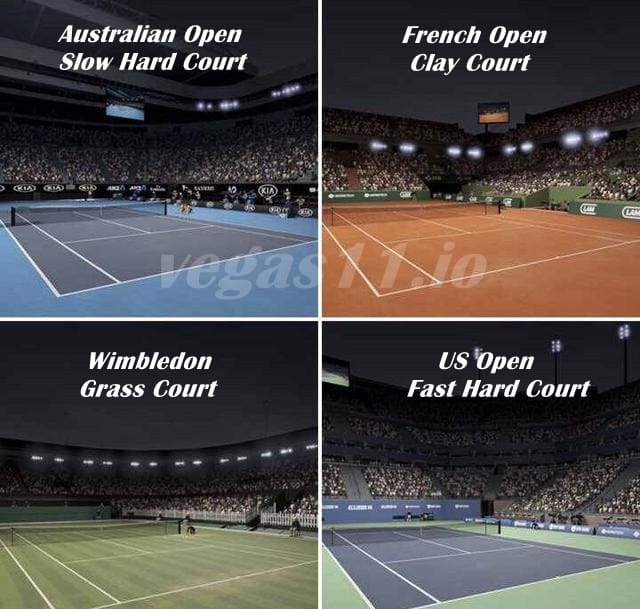
Grand Slam surfaces affect the game!
Each Grand Slam has a different court surface, which greatly affects the pace of play.
- The Australian Open and US Open use hard courts (medium speed).
- The French Open is played on clay (slow speed, slippery surface).
- Wimbledon uses grass (very fast speed, with low bounce).
Top players all aim for the achievement of a Career Grand Slam — winning all four of these tournaments across different years and surfaces.
Surprising Tennis Facts You Didn’t Know
Why is the third point 40 and not 45?
Medieval French players likely used clock faces for scoring. Over time, “45” was shortened to “40” because it was easier for the umpire to shout during play.
- 15 (Fifteen)
- 30 (Thirty)
- 40 (Forty)
45 (Forty-five)❌
40–30: Do you need two straight points to win?
No. At 40–30, you only need one point. The “two points in a row” rule only applies during a Deuce (40–40).
Why does a Tiebreak exist?
Introduced to prevent matches from lasting indefinitely. Before tiebreaks, players had to win by two full games (e.g., 10–8), which was physically draining.
Male players with a Career Grand Slam
As of 2025, 7 men have won all four majors: Don Budge, Rod Laver, Roy Emerson, Andre Agassi, Roger Federer, Rafael Nadal, and Novak Djokovic.
Female players with a Career Grand Slam
As of 2025, 6 women have achieved this: Serena Williams, Steffi Graf, Maria Sharapova, Chris Evert, Martina Navratilova, and Margaret Court.
Who has won a Calendar Grand Slam?
Winning all 4 in one season: Don Budge (1938), Maureen Connolly (1953), Rod Laver (1962, 1969), Margaret Court (1970), and Steffi Graf (1988).
The longest match in Grand Slam history
Wimbledon 2010: John Isner vs. Nicolas Mahut lasted 11 hours and 5 minutes. The final set score was 70–68.
Is there a time limit in tennis?
No. Matches continue until a winner is decided, regardless of how long it takes.
Why is clay the hardest surface to play on?
- Ball Speed: Clay absorbs energy, making bounces slower and higher.
- Sliding: Specific movement skills are required to turn quickly.
- Physicality: Rallies are longer, requiring more power and stamina.
When was the tiebreak invented?
It was first introduced at the 1970 US Open to ensure matches reached a timely conclusion.
Why do players wear all white at Wimbledon?
This is a British tradition from the 1800s. White was chosen to hide sweat patches, maintaining an “elegant” image.
How many calories are burned playing tennis?
Average players burn 400–700 calories per hour, depending on intensity and body weight.
Who is the youngest Grand Slam champion?
Men: Michael Chang (17y, 3m). Women: Martina Hingis (16y, 3m).
Do tennis rackets have vibration dampeners?
Yes. Small rubber pieces are placed at the bottom of the strings to reduce shock and hand discomfort.
What is Hawk-Eye?
A computer system using high-speed cameras to track ball paths and determine “In” or “Out” calls with high accuracy.
Which player scores most with lucky net cords?
Rafael Nadal is famous for his heavy topspin, which often results in pressure at the net and frequent lucky net cord winners.